Platform Engineering
From Chaos to Clarity: Build an Efficient Data Lake Through Smart Automation and Tags
Published
Aug 24, 2023
Focus
Centralized tagging, automation glue, and scalable data lake design
Core stack
Tags, Elasticsearch, Kafka, and cross-system observability
From Chaos to Clarity
Welcome to another edition of AwesomeOps. In this blog of automation bliss, we cover a solution designed years ago to help clients create simple, secure, and scalable data lakes capable of visualizing technical environments spread across public and private clouds.
Now, we know what you are thinking: Do we need dozens of tools, teams of engineers, and a large cash outlay just to get an effective and efficient data lake up and running?
The answer is no. You do not need any of that as long as you have a great design. To create a simple, secure, and scalable data lake, all you need is a sprinkle of tags, Elasticsearch, and a little bit of Kafka to spark a compute optimization metamorphosis in your organization.
And now, to the tech.
What The Data Lake?
Before jumping into the design, some context helps. A data lake is a system that ingests data from as many sources as there are grains of sand on Jones Beach, or at least as many internal and external systems as run within your environment.
More specifically, a data lake stores both structured and unstructured data without predefined schemas. Think raw machine logs, images, application telemetry, vendor management data, and IoT device data all landing in one place.
At first glance, storing all of this data together may not seem useful. The magic of the data lake is its ability to create insights from disparate systems that appear to have zero connection to each other. That is very different from a data mart or data warehouse, which rely on predefined schemas and explicit relationships between structured tables.
So how do we create proactive and valuable business insights when the lake has no predefined relationships? We combine smart automation with tags. Tags act as automation glue, creating linkages within both structured and unstructured data across a disparate set of systems.
Tags are Automation Magic
Around 2013, AWS released tags as a way to manage cloud assets. Since then, tags and related metadata have become a powerful way to classify and categorize assets in and outside the cloud. Modern systems worth their weight almost always have some concept of tags.
Tags come in different forms. Kubernetes, for example, implements them as Labels and Annotations. Labels are a fundamental part of how resources are organized, while annotations carry additional metadata for tools, automation, or human operators. Even one of the foundational aspects of many successful AI systems today is data tagging.
Because a data lake is effectively schemaless until read, and because it holds information from hundreds or thousands of unrelated systems, tags act as tech glue. They bind data together and create relationships that help organizations visualize and proactively detect issues up and down the Open Systems Interconnection stack.
The practical approach is simple: create a centralized tagging module and have all automation call it. Every time automation builds or configures a system, it also stamps that system and related services with the same shared set of metadata.
Virtual Machines Do Not Exist in Isolation
To understand the value of this design decision, consider a virtual machine. A VM does not exist on its own. It touches hardware, networks, CMDB records, security tools, identity systems, and environment classifications.
If every one of those related systems receives the same set of descriptive tags during automated build and configuration, the data lake can later query those tags to correlate everything associated with that VM.
That lets you move beyond brittle correlation based only on hostname or IP address and instead ask broader, more useful questions about environments, applications, business units, or operating states.
- Each VM runs on physical hardware such as servers with CPU, RAM, and disk.
- Each VM transmits data across virtual and physical networks such as routers, switches, Cisco ACI, or NSX-T.
- Each VM has records added to one or more external systems such as ServiceNow CMDB.
- Each VM must be registered with one or more external systems such as CrowdStrike, antivirus, or Red Hat Insights.
- Each VM talks to internal shared services used for centralized management, such as Active Directory or DHCP.
- Each VM is classified into an environment such as development, testing, or production.
To keep the example simple, assume each VM has two related components for each item above. That means one VM is tied to twelve separate systems. If all twelve systems hold the same descriptive tags, then all generated or collected data can be associated later by querying those tags in the lake.
Without tags, you are often limited to a single metric such as IP or hostname, and even those values may vary between systems. With tags, you can ask much more powerful questions like: show me everything in the dev environment. That is where the real magic happens.
The Big Picture and Architecture Design
Below is a use case architecture we have used for years to help clients visualize their environment in meaningful ways.
In the era of Artificial Intelligence and Machine Learning, the most important ideas are not simply the shiny tools and methods used to create new technology. The real foundation is how data moves from the bottom of the OSI stack to the top, where users interact with the business.
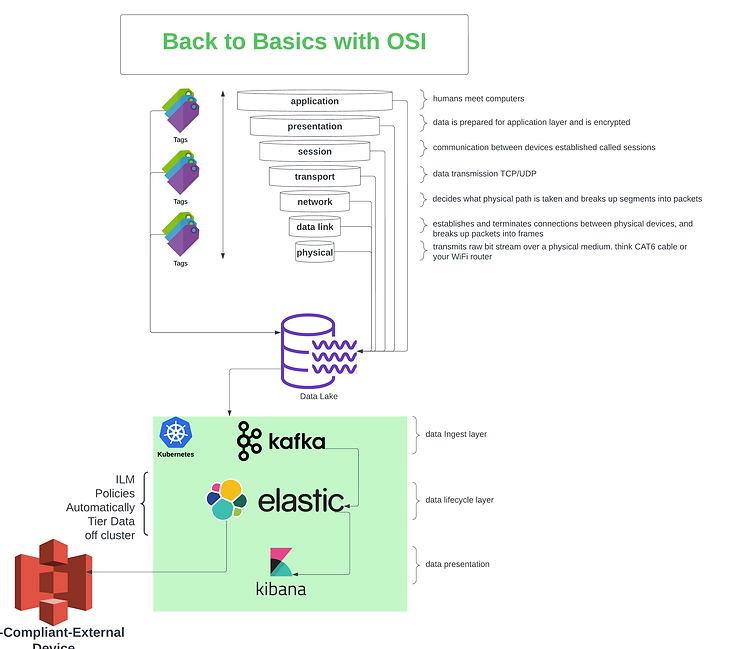
Organizations need insight into every aspect of how the business operates, and because technology drives business, observability in IT is critical to business success. To achieve full visibility, you need to collect, track, and visualize every frame of every packet as it moves from the physical layer to the application layer.
Picture throwing a stone into a pond. The initial wave ring is small, but the ripples expand outward into larger and larger waves. IT behaves the same way. Small issues at the physical layer propagate upward and eventually become major user-facing problems in internal line-of-business and public-facing applications.
By implementing tags within a data lake, teams gain the ability to trace and track issues at each layer of the stack. That helps reduce outages, improve customer experience, lower time to resolution, and save time and money.
Next Time On AwesomeOps
Part two of this multipart series will focus on how to maintain a secure, scalable data lake backed by Elasticsearch with only a few engineers, some Kafka, Elastic ILMs, external storage, and tags.
Hopefully this series is helpful to everyone on the journey of automation. As Kafka wrote in The Metamorphosis, “But instead of the five short steps of his former life, there were now an infinite number of long ones to be taken.” Change is inevitable and painful, but once you start down a new path, a whole new world opens up.
Good luck with your data lake.
Key takeaway
Ready to automate smarter?
A data lake becomes far more valuable when automation stamps shared tags across every connected system, turning disconnected telemetry into a searchable, cross-platform map of your environment.